
After relaxing in Spain for six weeks we were rested and ready for a month of faster-paced travel (though still slow by the standards of many). We started with a flight to Budapest for a five-night stay.
We had grouped the sites we wanted to visit in Budapest into three walkable areas with a few extras if we had time. You can walk to almost everything, but a couple of well-timed transit trips saved our feet and allowed us to see more.
Budapest has two distinct sections as a result of combining the two cities of Buda and Pest. Divided by the Danube River, the cities were connected by the Chain Bridge in 1849 and then joined and renamed Budapest in 1873. The Pest side is generally flat and filled with bars, restaurants, shops, and the Hungarian National Parliament. Buda’s hillier terrain is topped with historical architectural delights that are wonderful to explore and offer panoramic views of the Danube and Pest.
Pest highlights (Day 1)
We stayed at a hotel on the Pest side so visiting the sites on that side of the river was a logical first walking route. We ended the day with a wander through the Jewish Quarter.

A quick walk from our hotel on our first evening. 
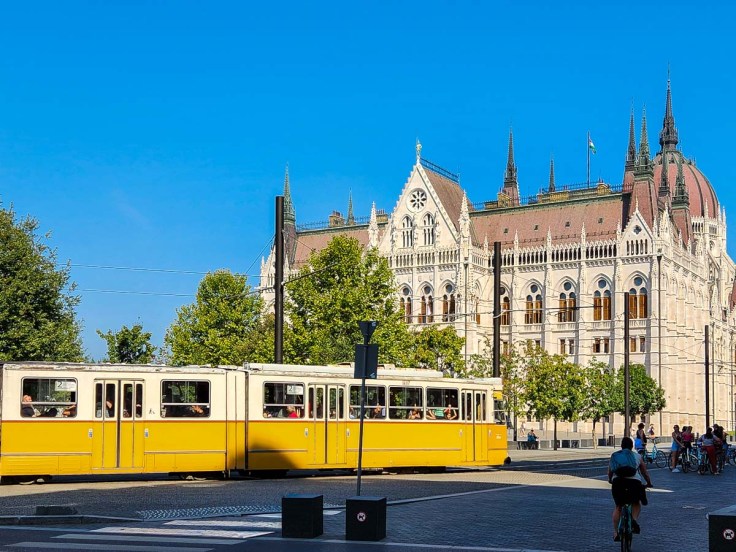
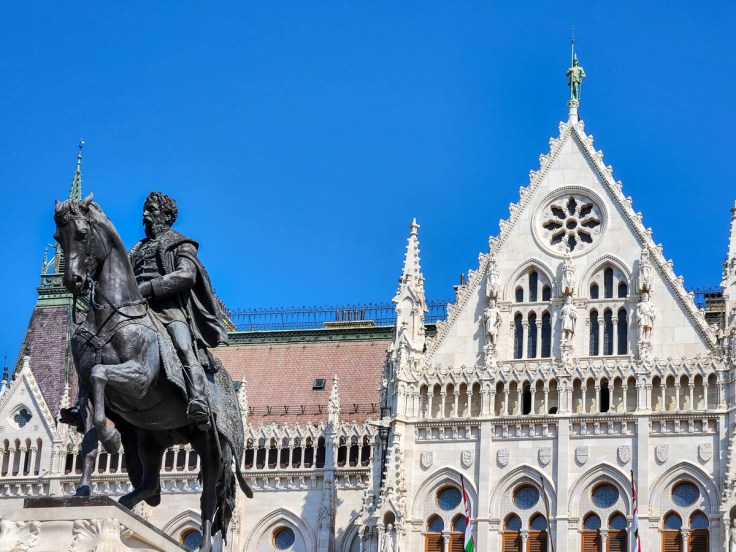

Hungarian National Parliament 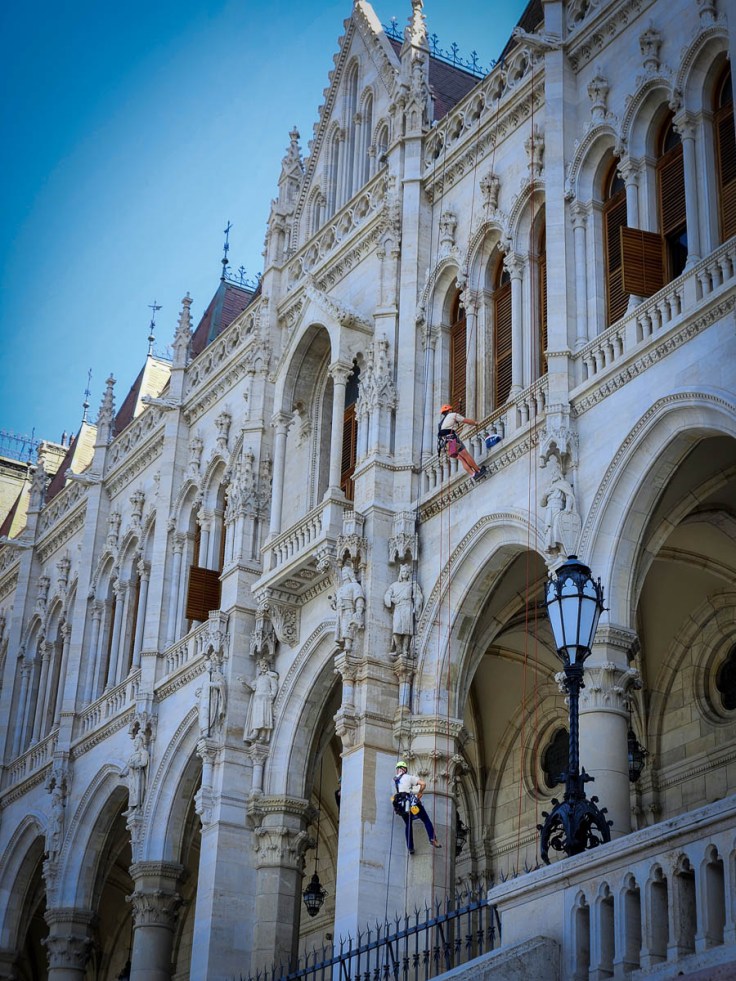
Workers scale the parliament’s walls 
End view of the parliament buildings 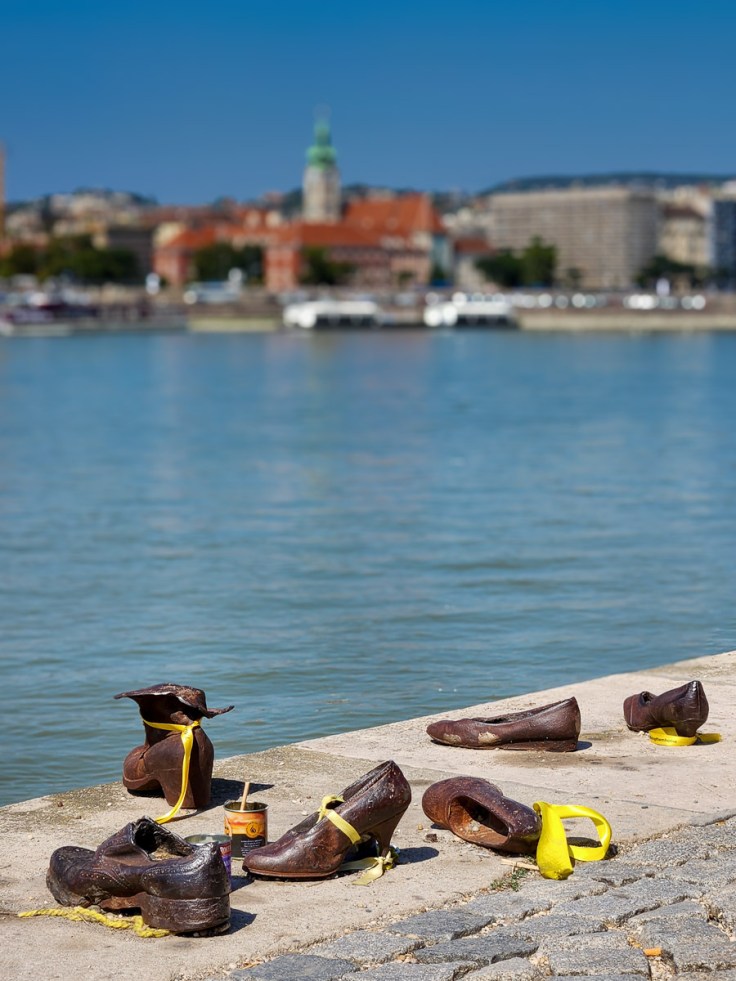
Shoes on the Danube – a moving memorial sculpture to Jews who were slain at the edge of the river, 1944-45 
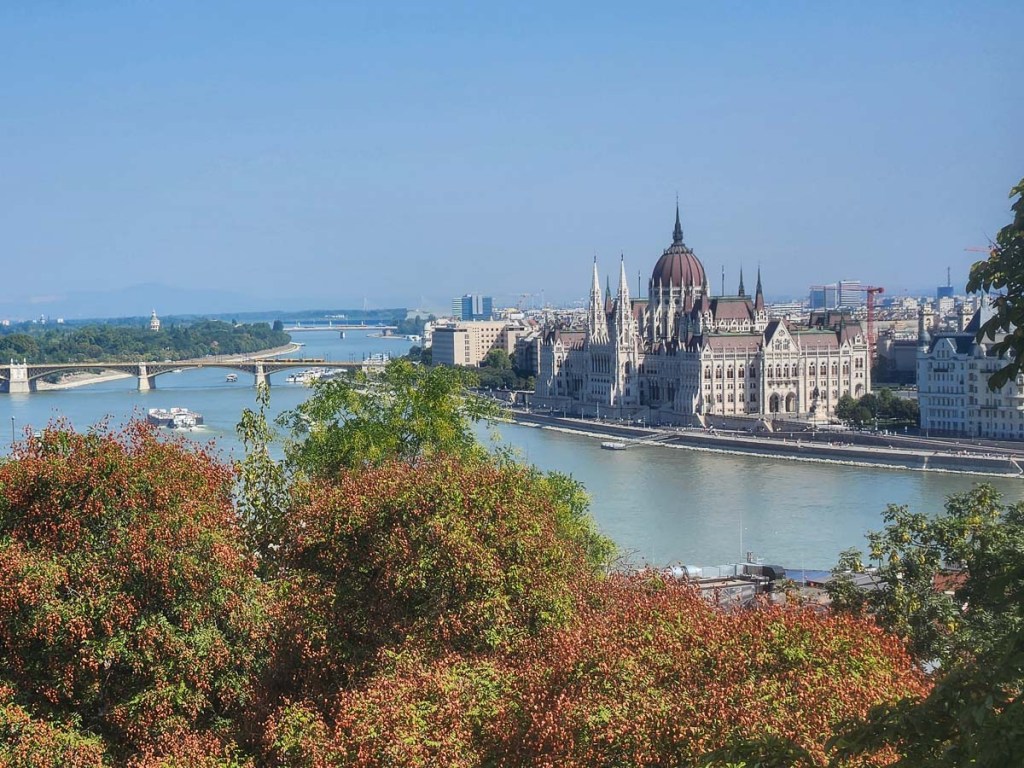
The Chain Bridge with Budapest Castle 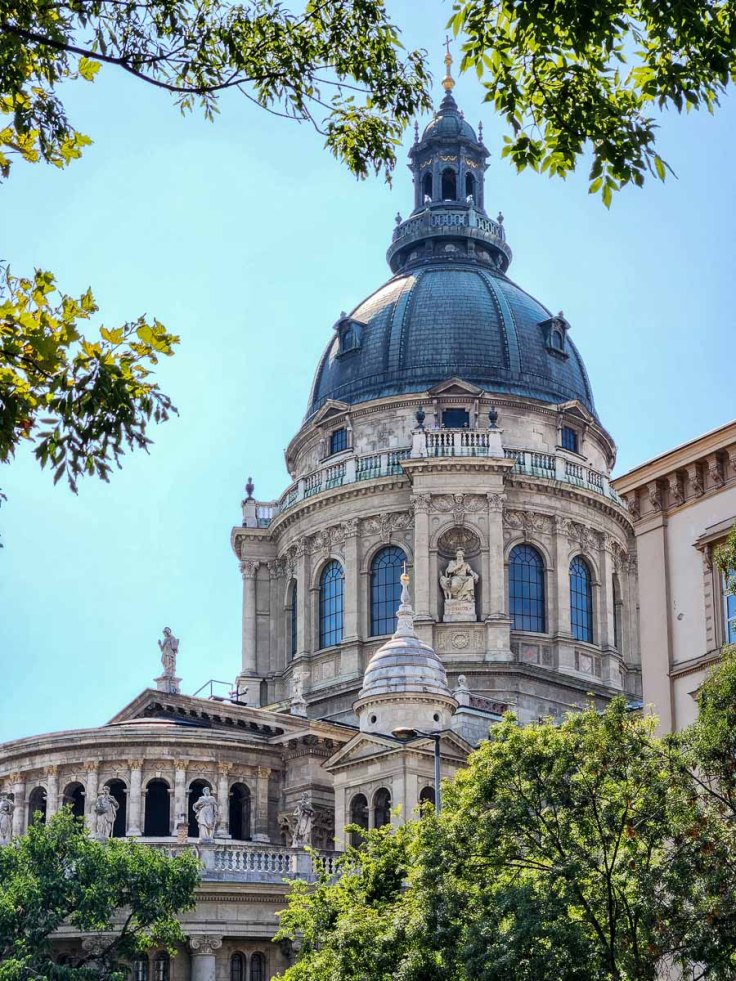
St. Stephen’s Basilica 
Dohany Street Synagogue 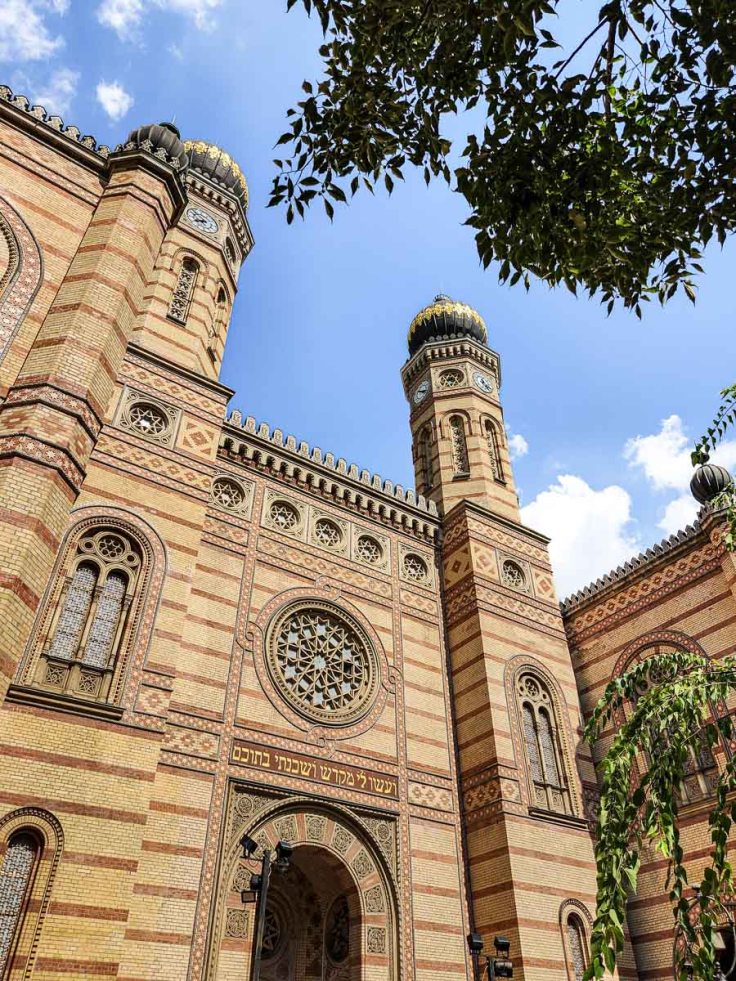
AKA The Great Synagogue 
Moon sculpture (or not–on another day, we observed a couple of fellows inflating this “sculpture” and hoisting it up)
Buda highlights (Day 2)
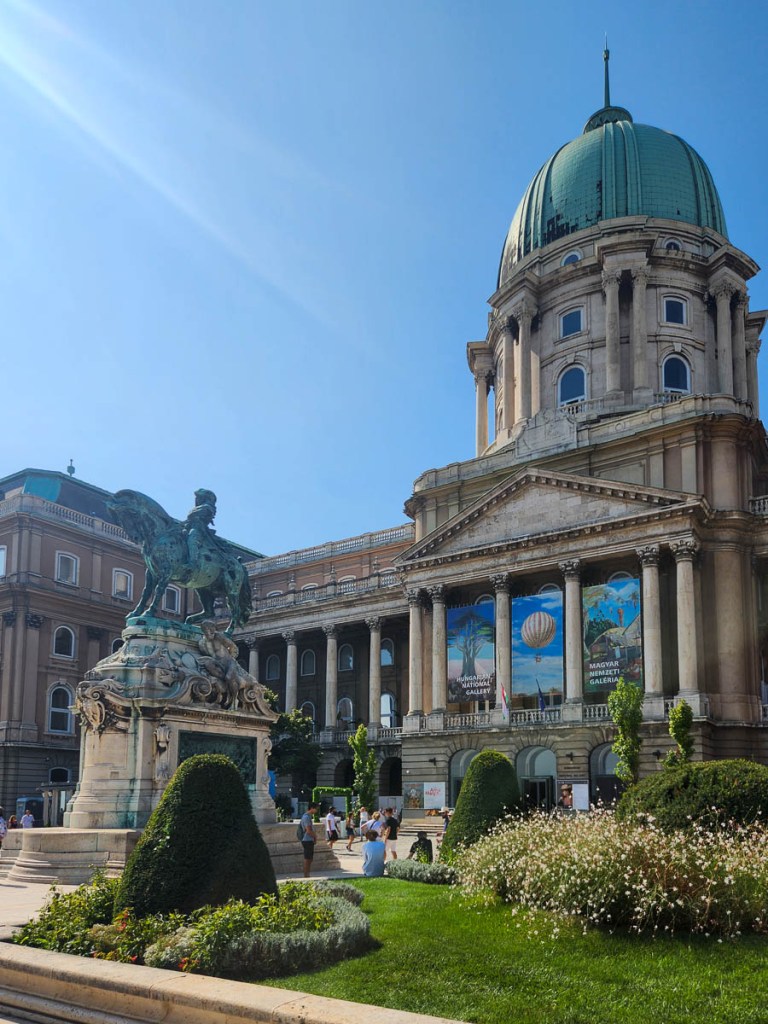
On day two, we crossed the river and headed up to Castle Hill by bus. This area is home to many sites and fantastic views. We walked first to Buda Castle (also known as the Royal Palace or Royal Castle), which now houses the Hungarian National Gallery, the Budapest Historical Museum, and the National Széchényi Library. We walked around and through the castle compound. Though a large area was blocked off for restoration or renovation, we were surprised how much we could access beyond the front of the building, including coming across the beautifully restored Royal Riding Hall, and a view out the back of Castle Hill.

Royal Riding Hall behind the castle, recently reconstructed and now used as an event venue 

The bus had dropped us roughly between the Buda Castle and Fisherman’s Bastion. We walked back to that area, where there were several blocks of restaurants and shops, ate lunch, and continued on to the other side of Castle Hill. As the Church of the Assumption of the Buda Castle, known more commonly as Matthias Church, came into view, we knew we had found Holy Trinity Square. The church’s colourfully tiled roof creates an almost whimsical feel, though the church completely dominates the square. Behind it, overlooking the Danube, are the Disney-esque turrets and arches of the Fisherman’s Bastion lookout.
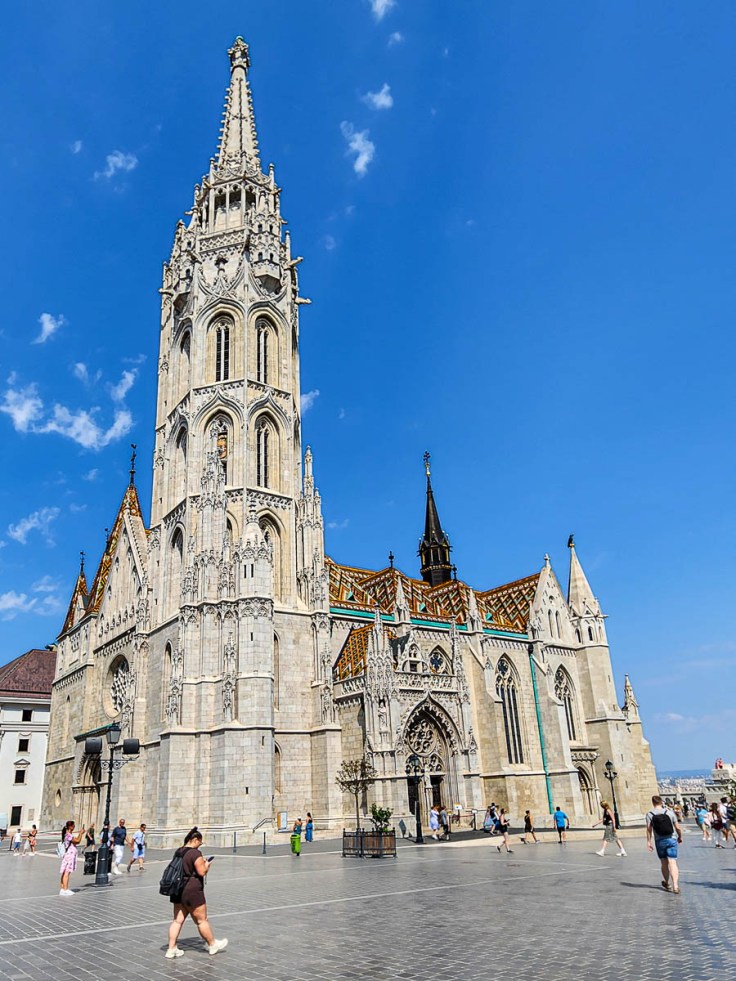
Matthias Church 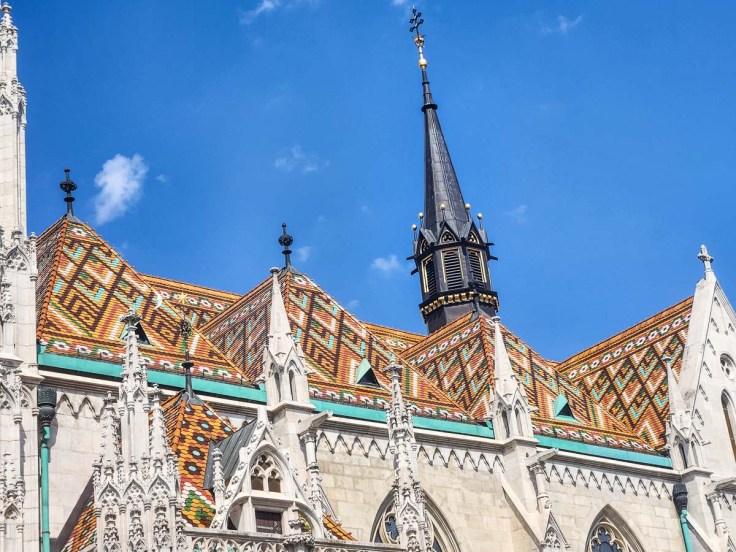
Matthias Church roof detail 
Fisherman’s Bastion 
A view from Fisherman’s Bastion
More Pest (Days 3 and 4)
For our remaining two days in Budapest, we explored new areas, and revisited ones we’d only passed through, like the Jewish Quarter.
Ruin Bars
Ruin Bars are social venues that have been set up in abandoned buildings. They began about 20 years ago and many of them are in decaying buildings in the Jewish Quarter. We went for a daytime drink in Szimpla Kert, one of the oldest ruin bars, and found a wonderfully eclectic space worthy of our explorations. Photographers must love it there–many rooms would make for intriguing portrait backgrounds. It was market day at the bar, with tables of artisanal products lining the entry hallway. Elsewhere, people chatted over drinks or captured content for their Instagram accounts. The evening vibe with live music, lighting effects, and packed spaces, must offer a completely different environment.

Szimpla Kert (Simple Garden) ruin bar 
One of many rooms in Szimpla Kert 
Szimpla Kert
Városliget (City Park)
We chose to travel on transit to Budapest’s City Park (about 4km away) to save our feet for the park itself. Many head there for the Széchenyi Thermal Baths. Though we didn’t see the baths themselves, the building was lovely from the outside and we were able to wander into the Baroque-like lobby. The gardens were colourful and provided a pretty background as a tethered red-striped hot air balloon, which we had seen from Castle Hill on the other side of the Danube, ascended and descended in another section of the park.
As we traversed the park to our next target, we came across the House of Music nestled in the forest. We couldn’t see the inside, but the outdoor performance space was stunning. The terraced seating was surrounded by gardens and the sheltering roof evoked clouds of butterflies and giant sunbeams. I’ve since learned that the building is just as beautiful inside and houses a terrific museum.
Another area of the park contains the Vajdahunyad Castle. Built in 1896, the castle showcases an eclectic evolution of architectural styles in its varied rooflines. Across the pedestrian street from the castle is a little Catholic church called the Ják Chapel, named for its inspiration, the 13th-century Abbey Church in Ják in Western Hungary.
At one entrance of the park is Heroes’ Square and its centrepiece, the Millenium Monument. When we were there, the soaring monument was fenced and shrouded as it was undergoing restoration so we were only able to see the two colonnades that bracket the central column.
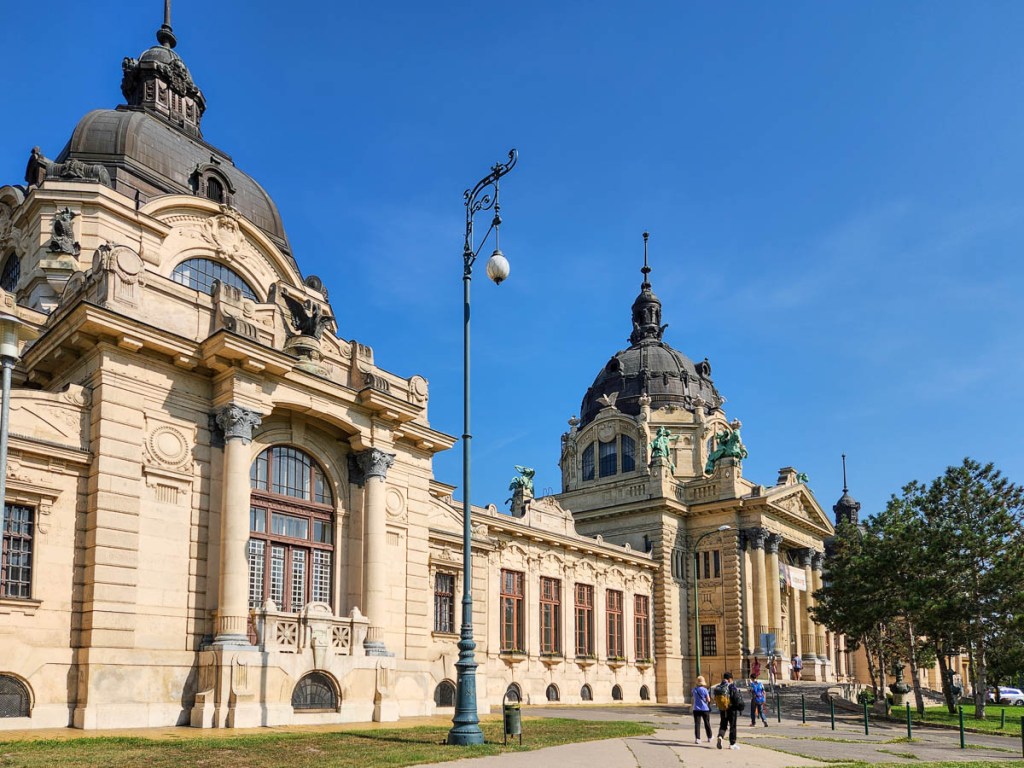
Széchenyi Thermal Baths 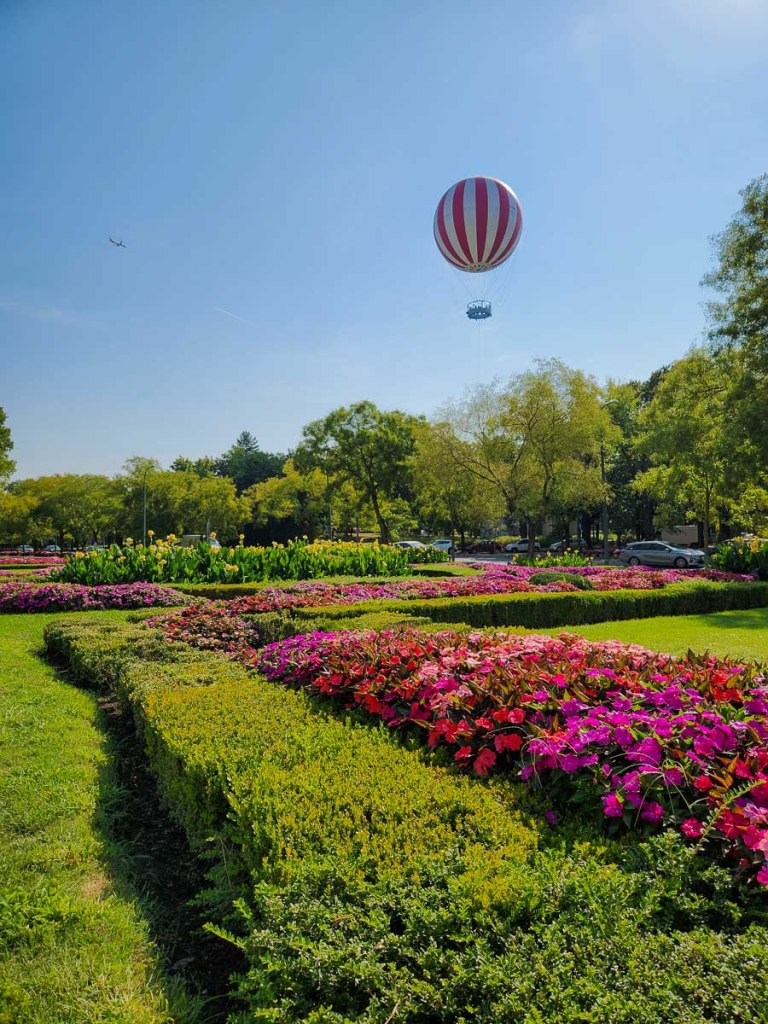
Gardens in front of the baths 
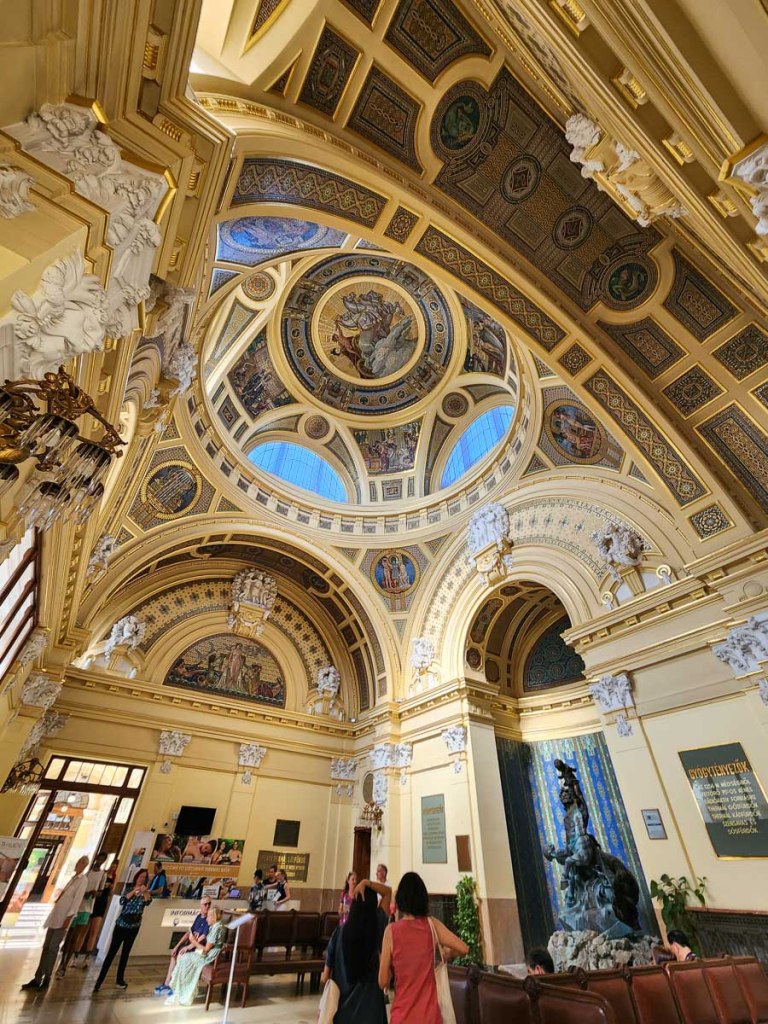
Széchenyi lobby 
Millennium Monument in Heroes’ Square (the main section was fenced and under renovation) 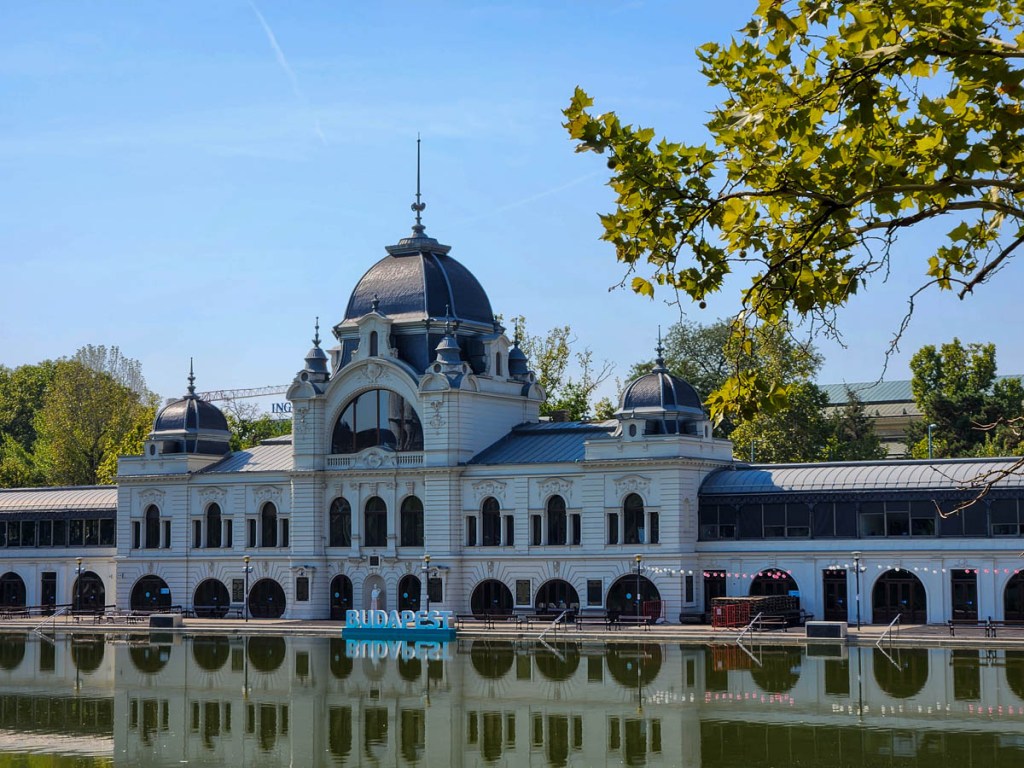

Amphitheatre outside of the House of Music 
Ják Chapel 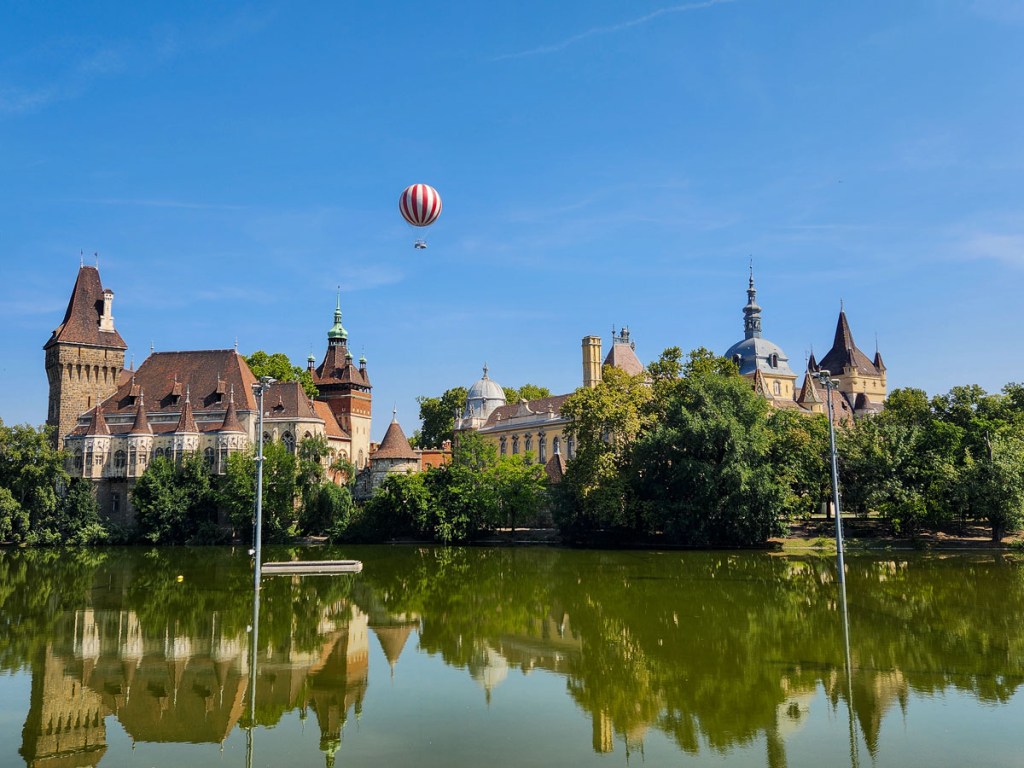
Vajdahunyad Castle
Restaurants
We stayed at a hotel that offered breakfast, but ate out for lunch and dinner. The area where we were staying was filled with restaurants and bars spoiling us for choice.
One morning we thought we’d stop by the New York Cafe, a tourist hotspot, for a coffee and to see the beautifully restored Victorian space, but arrived without a reservation to find a lengthy queue. Learn from our mistake and make a reservation if you can, even if just for coffee and to ogle the gorgeous interior.
We were more successful at another hotspot (for both locals and tourists), Retro Lángos, where we tried our first lángos–a large frybread topped with sour cream, cheese and other fixings. We could have easily shared one for lunch. They were delicious, but too rich and generous, though the other diners didn’t seem to be having any issues.
Twentysix was another lunch highlight with its beautiful garden setting. For Sale bar offered traditional fare at tourist prices including a surprising 12% service charge automatically added to the bill (not the norm in Budapest). A funky place where you can read the notes that are pinned many layers deep all over the walls. Don’t try to be tidy with your peanut shells–the servers just brush them onto the floor anyway.

Lángos topped with sour cream, cheese, and fried onions (foreground), chicken and other goodies (background) 
Chicken with crepes 
Twentysix Budapest 
For Sale restaurant across from the Central Market 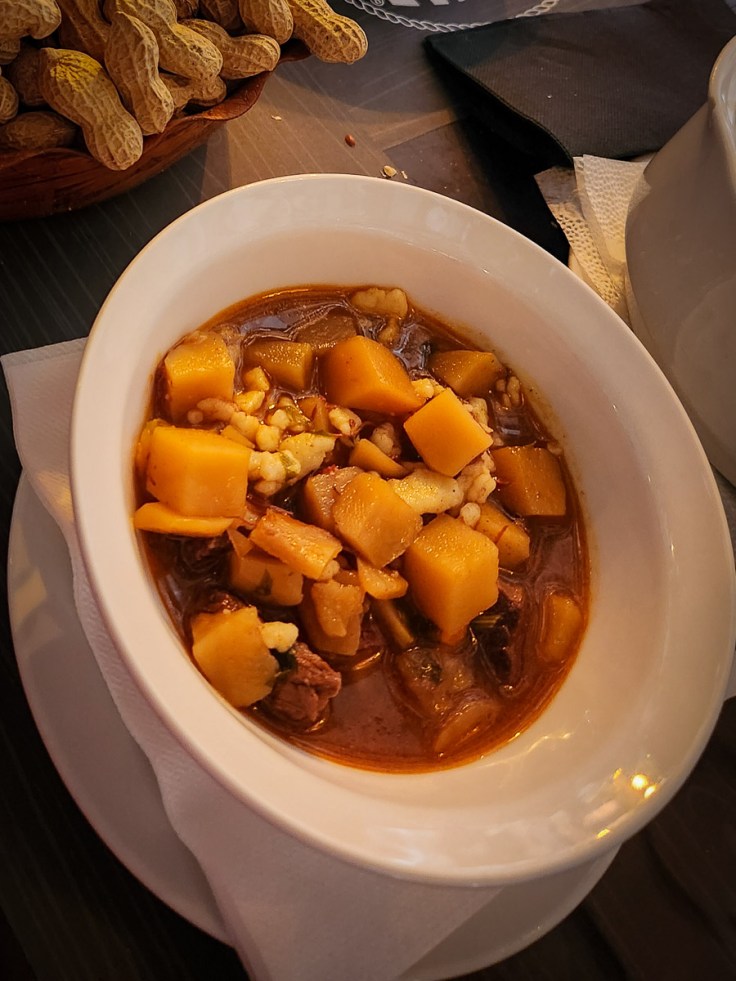
Goulash at the For Sale bar
Danube River Cruise at Night
Though it’s a popular tourist activity, we had no plans to ride a boat up and down the Danube, especially since we could walk the banks of the river easily, even at night. We’re glad we decided to book last-night trip, though. The embarkation point was just a short walk away. And for €20 each, we spent about an hour, a glass of wine or beer in hand, getting a different perspective on some fantastic structures, and motoring farther downriver than we had managed to get on our own.
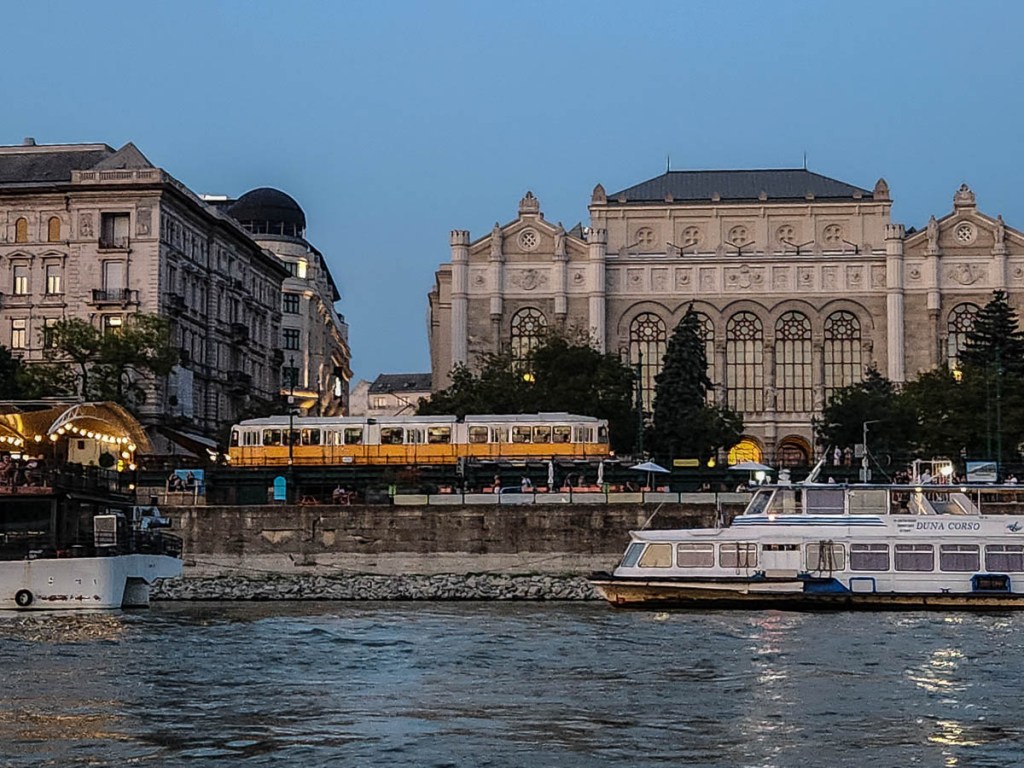
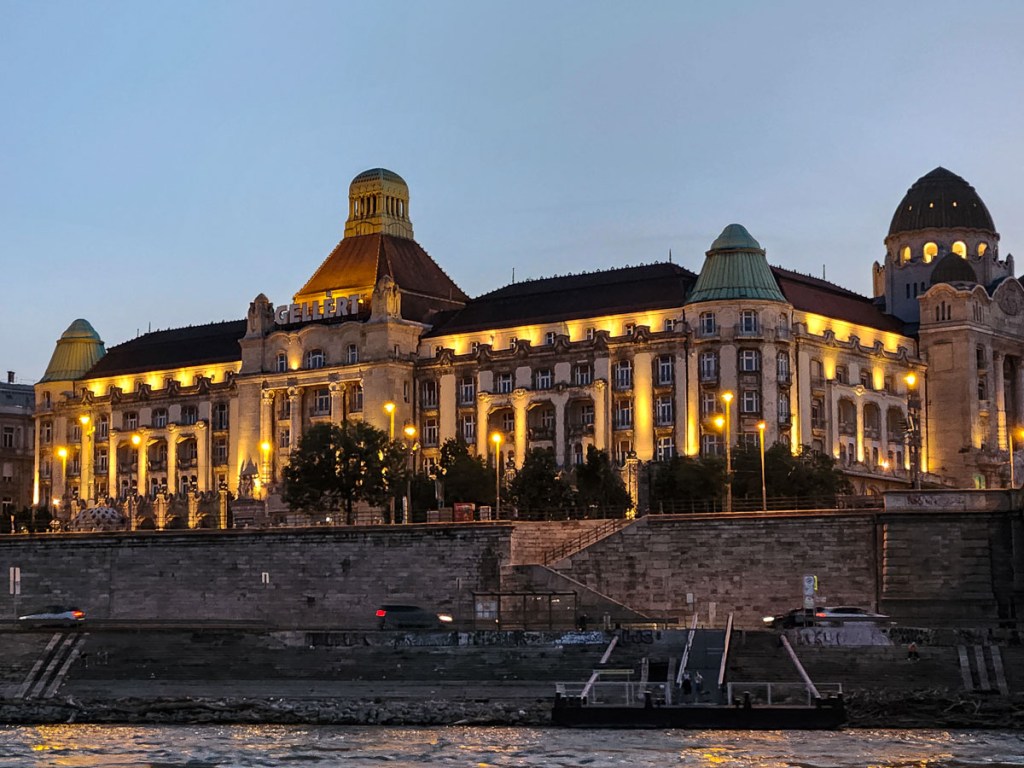
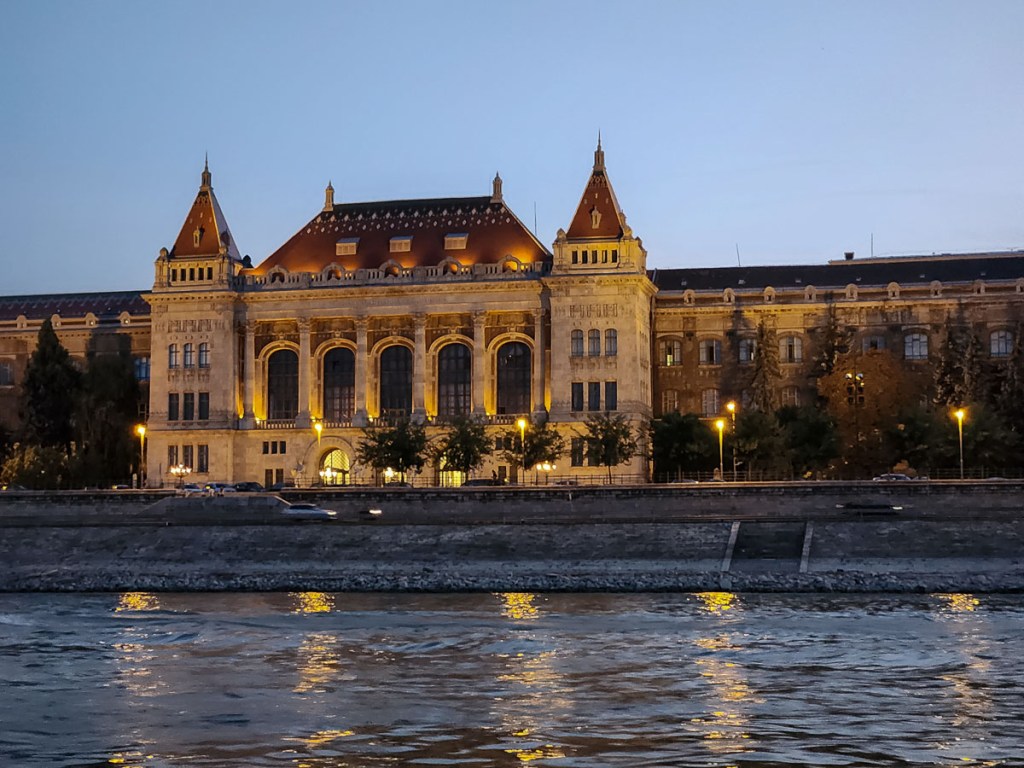
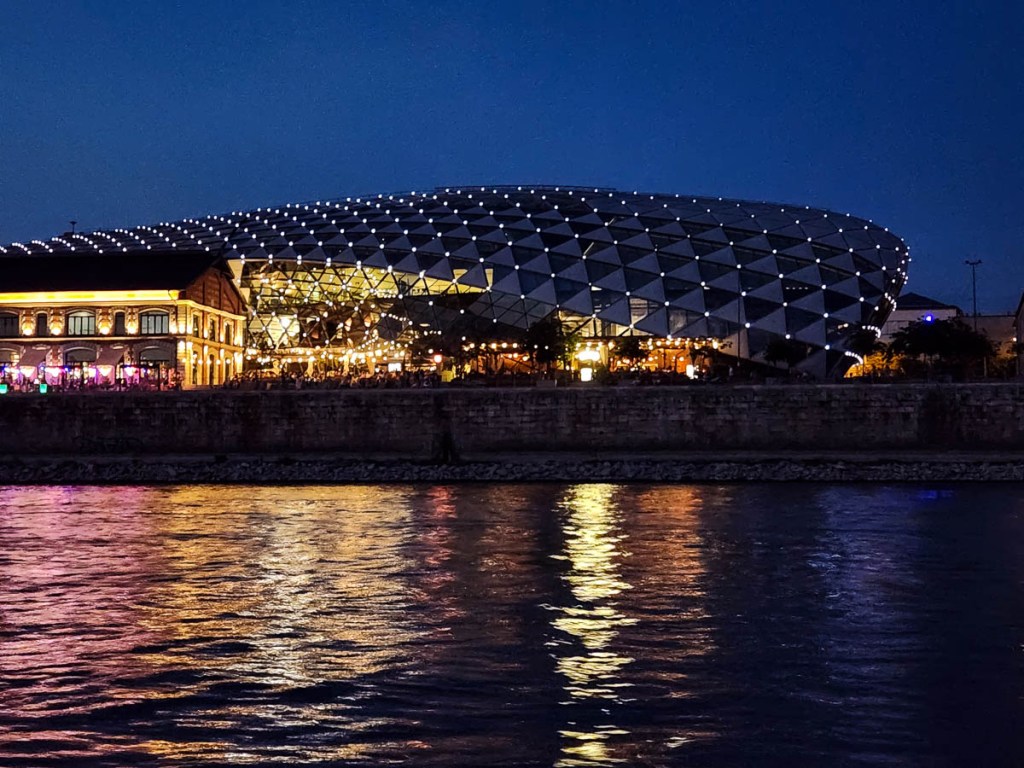
Bálna (Whale) Terasz event space and restaurant 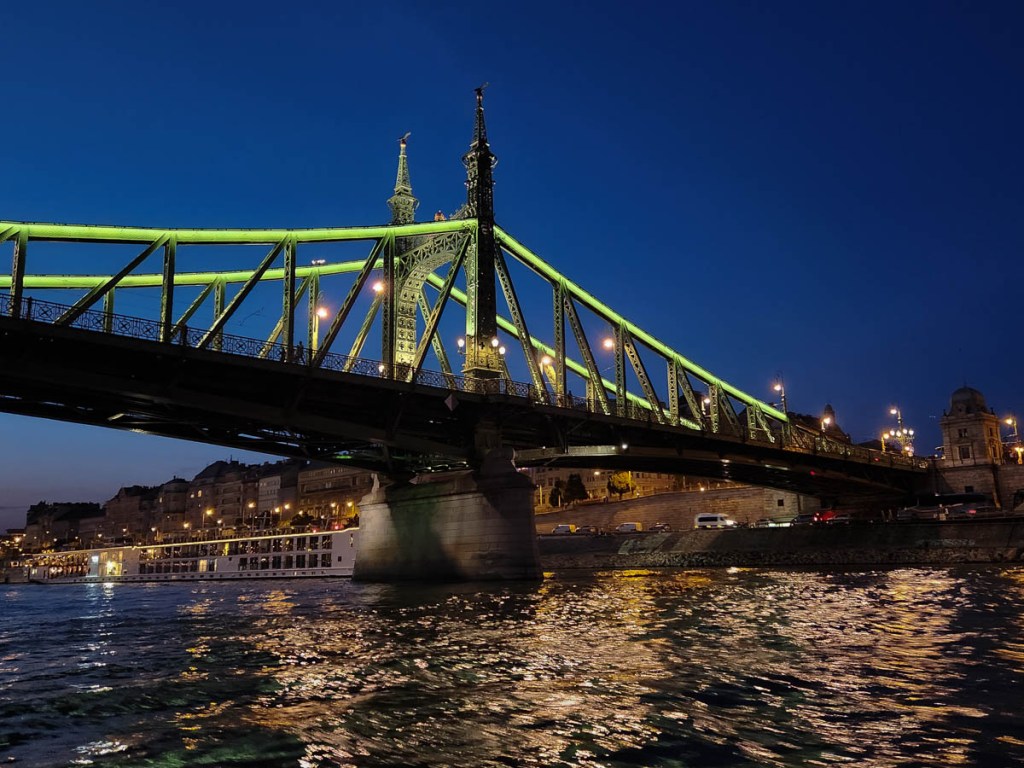

Chain Bridge 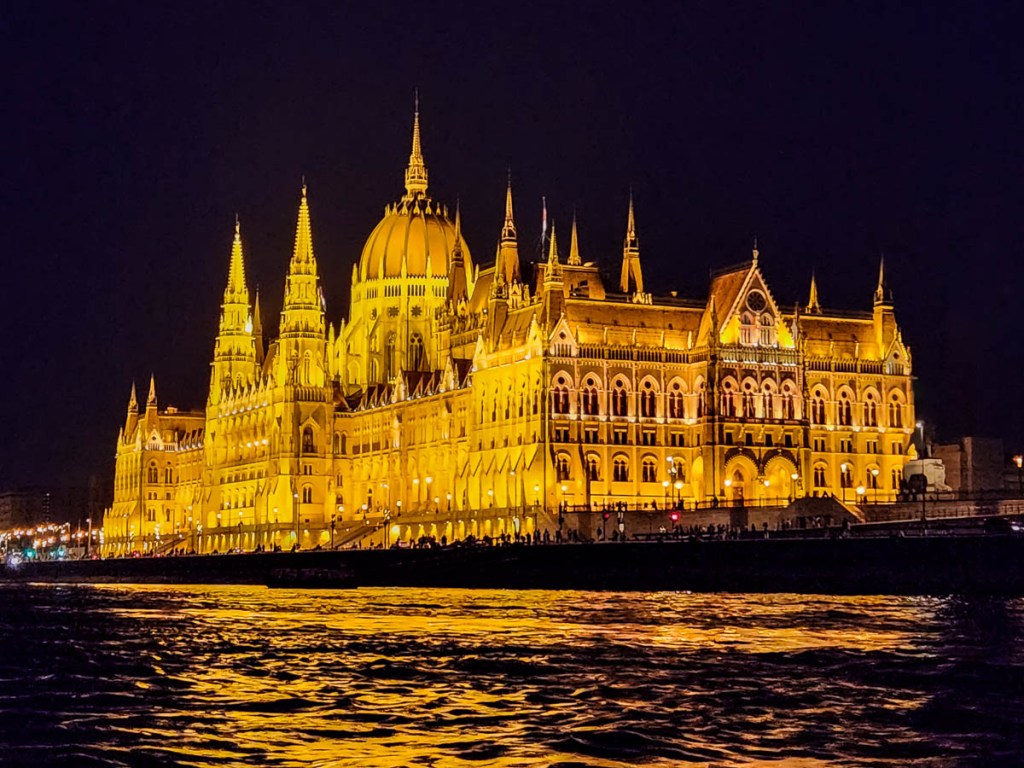
Hungarian Parliament 
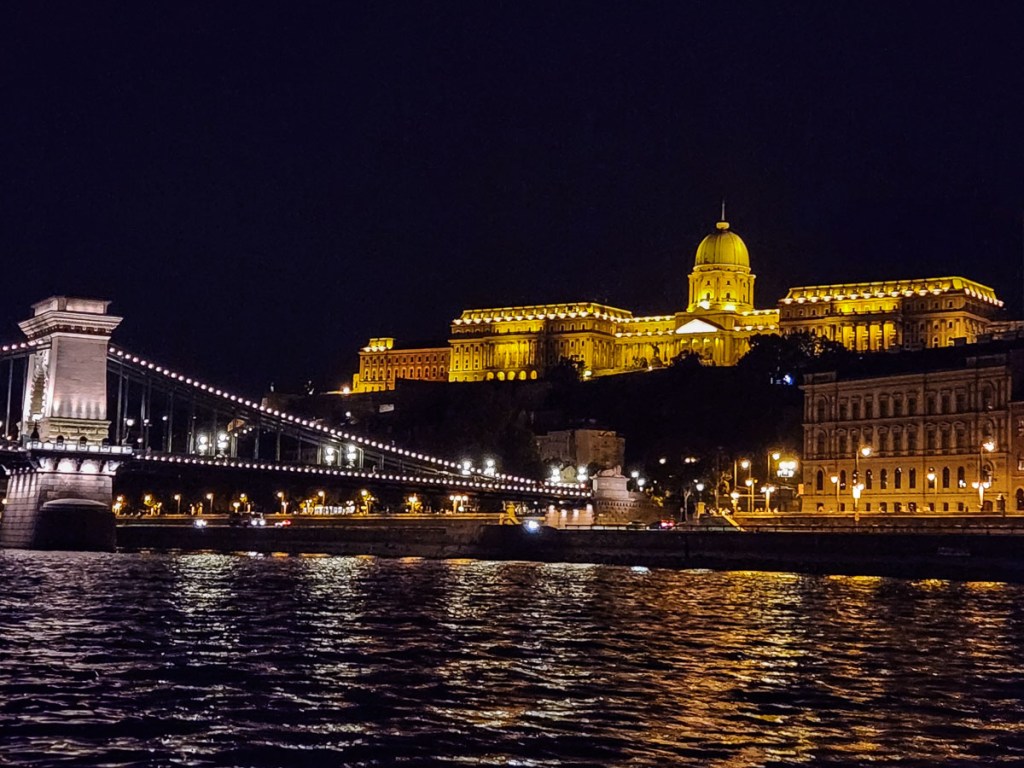
Buda Castle
TripBits
- From the airport to town: Take the 100e bus. It costs more than the regular bus, but much less than taxis. There are only three stops on the 40-minute route. We were staying in town and the final stop left us with only a few hundred metres to walk to our hotel. 2200 HUF (about $8 CAD) per person. Tap your card/phone on the bus. Don’t worry if the charge doesn’t come through right away and that you don’t have a ticket to prove payment. Inspectors (should you run into one–we didn’t) can also tap your card/phone to check validity.
- For all transit: Download the BudapestGO app to view and purchase tickets and to navigate through Budapest. Anyone 65 and over travels free (just carry official picture ID with birthdate–Ken’s wallet had been stolen in Spain so he used his NEXUS card rather than carry a passport). For our purposes, we found it better to purchase a 24-hour pass for me on a few days (a side benefit is that 24-hour passes or longer do not require validation–an extra step and oft-forgotten, resulting in a fine).
- Evening cruise: There are many on offer, including the popular all-you-can-drink-Prosecco cruises, but we chose Legenda’s Danube Legend.

 Life: Phase Next
Hey, Kathy. Thanks for popping in! 🙂
LikeLike
Love your life Coral, thx for sharing, cuz Kathy here
LikeLike